Saturday, August 14, 2010

Sweet Water Apples

Often , the leaves of the sweet water apple tree found their way into his room, invariably alighting on his trigonometry textbook, which was left wide open on all days at all times by habit . As the leaves of the pages fluttered with leaves from the tree, Muni felt the sines , cosines and tangents fluttering through the room and magnetically funneling into his head, as he lay on his bed beside the window of his room.

Summer lethargy and a heavy humid stagnation infested this little room that Muni stayed in as a paying guest since the past four months. The trigonometry was a sidekick. He taught the land lady’s fourteen year old monster mathematics. While in the mornings, he went about this coastal town, trying to find a reason why he had come to the place at all.

Ever since the pat on his back given by his principle at college, for being an outstanding student of his batch on graduation day, Muni had been disgusted at his whole smug self and decided that he would do anything in life except make use of his graduation degree.

Sweet water apples . They came in pink and white. With pecks from the sparrows . Like kisses implanted specially for Muni. When Muni first came to this sleepy town, merely out of a random one fine morning whim rather than any logically aimed destination, he went straight to the 22nd street off the temple complex where stood a pink bougainvillea bush arresting any passerby with its vanity. Behind this bush was the house where Muni was looking to be a paying guest. And behind the house was the pink water apple tree. Well, the pink was from the fruit which hung voluptuously from its high branches, virgin fruits kissed by the birds, and challenging Muni to come and consume them. Muni agreed to move in just for the tree, the room having gone completely out of his selection criteria. Luckily, his room on the first floor faced the backyard, and was in full uninterrupted view of his new beloved tree.

“Muni dada?”, the little landlady’s monster peered into the room with watery sparkling eyes. “Yesss , my lord!,” replied Muni, eyes still closed , not stirring from his bed. “Today, I fell in school while playing! And there was so much blood , that even my teacher was nice to me,” he was saying with victorious pride beaming in his voice. “ The teacher told me not to study today,” very quickly, and confidently, he uttered these last words, and waited to see the effect on Muni dada’s face.

Smiling on the sly, Muni half opened his eyes and peered down his bed at this little plaintiff. His nose had a little speck of soot on it, and he was standing on the threshold, his wounded thrust to the front so that there be no doubt about his claim. Here was Napoleon Bonaparte himself, asking Muni dada release from his trigonometry class, with the help of a hopeless claim. “Your teacher told you not to study?! Wow, I had never come across those kinds before!”, Muni said with mild pretence of amusement. “Okay, no class today”, so saying he gave the little Napoleon a wink and got up to look out of the window.

The smell of wet earth wafted up to his room as far somewhere, rain clouds shattered. Grey and pink was the palette of the landscape this evening. He peered back at his doorway and saw Napoleon still standing in the frame, looking unsure. He had been hit by the unseen circumstance that , though he was free from his torturous class, his other friends in the neighborhood were nevertheless slogging in their classes . So he was left with no one to play at the moment. Muni scanned this little figure, deep in his sudden crises, and at once understood.

“ Come inside. There’s no class, but we could play something , no? Want a water apple? ”

Napoleon's eyes widened into a grin. “Yes! Ok. I will climb the tree and throw them down. You pick them up!” So saying he ran downstairs . Muni hadn’t expected this. He was referring to the fruits in the bowl in his room. Nevertheless, a tree adventure seemed much more alluring.

An unequal duo, they seemed. Delicate little hands searching out the sweeter bird pecked fruits, little dusty feet dangling from fragile branches which had the complete trust of a boy. Standing below, stubby fingers and course nails picked up the fallen fruits from the fresh rain soaked soil. Slowly piling up in the vessel, each fruit, made its own little clink as it settled into a new found company of pink peers, hand -picked by their very trustworthy Napoleon.

Back in the room, happy in exhaustion and fruition, the team shook hands and sealed a silent bond in all its solemnity. The room glowed a tinge of pink twilight on that grey evening.

With a satisfied silence, Muni and Napoleon perched on top of the window sill , surrendering to sweet water apples, rain drops and that odd evening in the life of a man and a boy, where nothingness made them equal.

Saturday, July 3, 2010

The Sarukkai effect / Summer school at MCPH Manipal

Wide eyed I enter Manipal. The University town is shrouded in a thin sheet of rain and I see umbrellas dodging about over white lab coats. I am here for the Summer school of Philosophy and Humanities on the ‘Idea of Justice’. Sundar Sarukkai , the master mind of this school, is on his fresh new venture , a new post graduate degree in interdisciplinary Humanities at Manipal . I am here on self probation, with my antennae receptors , alert and ready to catch on to fresh piece of knowledge that comes floating by. Apprehensive about finding myself without a firm grounding in this field, I am immediately put to ease after my first encounter with Sundar Sarukkai. He makes sense. And when philosophy makes sense, I doubt if anyone can resist its pull.

The first session is on Ideas and concepts. I enter the class thinking I am ready to take the ‘Ideas and concepts’ of justice. Instead, I am faced with the question, What is an idea? And what is a concept? So obviously, I am now realizing , words are taken very seriously here! The discourse is tentative yet firm, extremely inquisitive yet firmly basic. There are no answers. Only questions. Sarukkai flings the word ‘justice’ about , bouncing it haywire, shaking it up, rattling it empty of its preconceptions, and beginning from the basics. Up there on the podium , he seems like a magician juggling very precariously with his oranges , yet with an innate charm. Ah, ‘innate’. The word is to be noted.

I am struck in my seat, paralyzed by the speed and clatter with which a million window shutters of my brain are opening up. I am reveling in the tickle of a new kind of confusion. The feeling that you are getting it , yet, you are not getting it, yet ,you feel sure you got it, when in fact , there is no way of getting it, is exhilarating. I have not understood something as a whole number, and this fractional non-understanding has motivated positively.

What is the meaning of justice? What is the synonym for it? Is the feeling of justice biologically or socially innate, if at all? Is it a personal concept or a social concept? Is justice a primal instinct or is it subordinated by ‘guilt’? Is justice the concept or is ‘Injustice’ the seed concept for justness to exist?

There is room for thought and reaction in class. Sarukkai flings sincere and inquisitive questions at us ; to which he seems to want the answers from us, and we feel responsible in some way, to get him out of his seemingly perplexed position of unknowing , only to find that he is probing us to probe more. He is trying to make us use our mental mechanisms in a novel way to think, and not telling us what to think. Unsettling, is the order of a Sarukkai class. Just when things seem to get ordinary, an exotic string of words are flung at you , which light sparks. So there comes up a question of, What is the Idea of a Chair? And What is the Concept of a chair? And then we go on to essentialise it into a ‘Chairhood’ that ultimately makes a chair a chair, a treehood that makes trees trees, a red(riding?)hood that makes red the red it is. Not to forget, the ‘theory-theory’ of the theory of concepts, and that a concept cannot have a definite definition except in terms of other concepts! So its all really a circle, pointing out successively only to lead back to itself. Back to square one, we could say, but it’s a square with a larger dimension now, and now it will take longer to get back to point A .We are in fact, getting ourselves a Kurukshetra built around us! Then there is Leibniz at point A, saying “Will we ever know, if the world doubles in the next instance?”

Will we?!

Saturday, June 26, 2010

FA 2010 - FTII, Pune


The Prabhat Bell calls for take.

Shot number 35 ! Film Appreciation 2010 ! Lights Camera Action ! Clap !

We are serenaded by the lilting and suave notes of our Pied piper , Suresh Chabria ji . With his magic lantern , he invites us into the powerful hypnosis that is Cinema. Synesthesia sets in. Our senses blur as the screen before our eyes lights up with Sergio Leone’s gunned outlaws, Kubrick’s waltzing spaceships, the inevitability of Apocalypse Now. Yes it is Apocalypse Now. An Apocalyptic dose of cinephilia.

Where is the Friend’s home? Kiarostami asks us on the first day, and we set out on a quest in search of our old friends, Films.( By the end of the course we pride in calling ourselves Foofs ; Friends of Old Films) We wind down the cobbled streets of time , and encounter our great grandfathers, the Lumiere Brothers, George Melies, D.W.Griffith and many more. We walk through the Narratives, past the Tableaux , up the hills of Montages, sail past illusory lakes.We enter the world of Sonimage, now Real , now fragmented, through Surreal waters, and ride the gales of wretched Realism .

Edvard Munch Screams through the Cabinet of Dr.Caligari, and we know the Germans have Expressed through their Metropolis! As the Bicycle thief rushes past us, and we are left stranded on the pavement watching Breathless, Pierrot the fool, catches us unawares and splashes the walls around us with colour! Swept away by the Wave of the French Nouveau, we land in midst of a Red Dessert, and find an oasis of metaphors, satires, the Blues of a trapped lady, the Reds of passion blood , the yellows of summer and sadness. We walk into the lush green fields of an Ozu landscape and find Seven Samurais waiting to attack us with an effusion of Kurosawa’s passing seasons.

Eventually, we enter the Noir streets of the city , chased by shadowed figures, dark alleys, gunshots and cornered by femme fatales. Now and then a train rumbles along , and dark smoke shrouds the immaculate conscience of the city, making the city a place of the anti-heroes and Helens. We waltz to a labrynthian city symphonies and take a high ride with Thelma and Louise.

Meanwhile, halfway across the world, three fathers ,V. Damle, V.Shantaram and S.Fatehlal sit under the wisdom tree of Indian Cinema and sound the Prabhat trumpet into history. In the distance, standing on top of the great Mount Melodrama, Nargis holds the cross on her shoulders, and questions her son, “Tujhe ma chahiye ya chaney?” This is the quintessential Indian emotiscape, the Indian Madonna who sheds rivers of blood to inundate fields of a Bharat who brackets his stories by proclaiming, “Mein Bharat hoon” while, somewhere in the dingy lanes of this Bharat , a cynical bard sings ‘Jinhe naaz hai hind par who kahaan hai?’ We are yet to get an answer to that question amidst throes of War and Peace In the Name of God.

We meet Bhai Miyaan and Bilaal, go in search of The other Song with Rasoolan bai, and marvel at the Great Indian School Show. The Digital Camera takes us a step too close to the human mindscape of Love sex and Dokha .

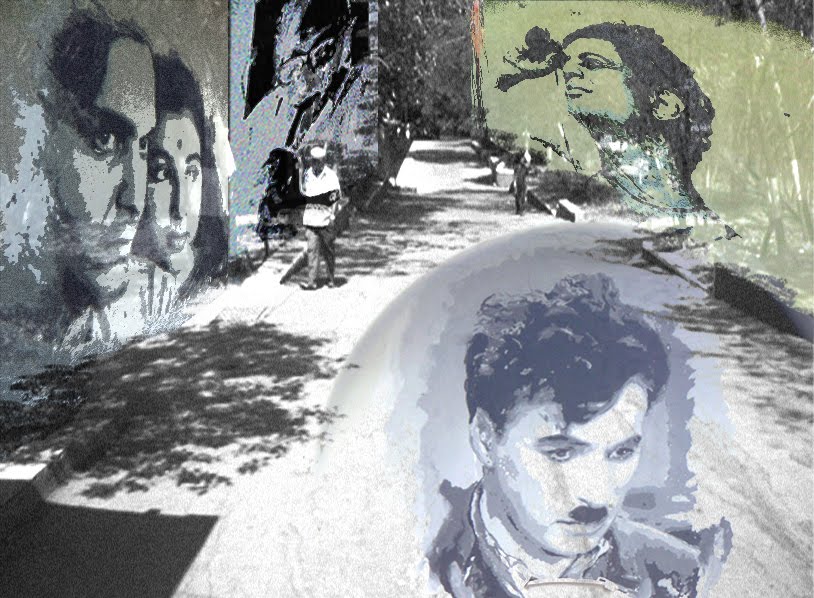
In the midst of it all it rains. The fancy umbrellas are out . The streets are sparkling wet in the early morning mist. The Chaplins, Mrinal Sens, Kurosawas, Toshiro Mifunes, Satyajit Rays and Ritwik Ghataks in FTII soak in the monsoon’s first showers and greet us with wizened visages as , we take our final walk down the FTII street, and meet again under the wisdom tree to sing songs of a new bond. We are the FA 2010.

Thursday, April 29, 2010

Sunday, March 21, 2010

A scene from Akahige (Red Beard ,1965) - Akira Kurosawa


Chobo, the little urchin thief , lies on the hospital bed , struggling for life , after consuming poison. Till yesterday he was chased away and cursed by the hospital nurses for stealing rice from the kitchen . Today, the nurses worry for him, as a mother for her dying child. An old myth of the hospital says that if all the kin of a dieing person called out his name into the well in the courtyard , the spirits would send him back from the otherworld. “ Chobo! Chobo! “ his little friend Otoyo ‘s screams echo from the well. Together , Otoyo and the nurses , bent upto their waists into the well, salty tears dripping into the well, call out, “ Chobo! Chobo!” tearing at their guts , as if their voices would lend life to the well. The sobbing screams pierce the silent air of death around. The water in the well ripples with Chobo’s final breath.

Thursday, March 4, 2010

Louis Kahn in Ahmedsaa Badsaa's city


Glittering city lights like neurons and cells spreading their connectors around. I enter IIM-A campus. Sodium lights reflect off lofty walls, all of brick and awe. I cant help feeling the excitement slivering through me. Sriram kaka takes me on a late night tour of Louis Kahn’s monastic campus, the Indian Institute of Management – Ahmedabad. It is shivering cold at 11 in the night and mist has descended over the brick fortress. Through the arches and student blocks with their heavy buttresses anchored to the ground, the bricks overwhelm one’s vision. In the almost ethereal walk at midnight, I suddenly run my hand over one of the walls, feeling brick and mortar in an attempt to make sure it is all real. The sudden slants of the brick arches and hooked lintels that defy the constricted massiveness of the built, take me by surprise. All at once, I am overcome with a sense of depression. I feel sad somehow, for the building. For the bricks that are stuck in there for eternity. For Louis Kahn himself, the outsider who came to this foreign land and sought to manifest and trap himself within the stoic bricks of India. I can almost feel that intensity of nothingness in those humungous circular punctures on the walls. With exotic migratory species of birds filling the midnight air of IIM with a morbidity of their screams, IIM falls asleep brick by brick.

The morning is almost shaken from its slumber by the hair raising chirping and rattle of what seems like a battalion of birds in the campus. House number 413.M.S.Sriram has peacocks in the garden. I go on another round of the brick fortress. This time it appears quite harmless and vulnerably exposed (literally) in the bare open. We maneuver through the great Louis Kahn court which looks like a great grand father whose grandchildren have not yet woken up. Walking past empty classrooms awaiting their designated students(quiet literally as each desk has the students name plate on it! ) the great Vikram Sarabhai Library ‘s circular arch looks ready to engulf the entire place like an enormous black hole. A mango tree gives the Harvard steps at the entrance a human touch, while an enormous Stanford ramp extends an invitation into the belly of the bricks. Meandering through the hostel blocks, I feel small, as moons of windows loom large above me giving glimpses into the life inside. While Kahn’s bricks make the old campus, Bimal Patel ‘s exposed concrete makes the new campus. I like the relief of the lightness of grey after an overdose of heavy brown bricks. Although in places there is the indecisiveness of a modernist, the new campus tries to balance well.

The Forum ( my reason for visiting Ahmedabad) is at Cept university. The place looks worn, active and full of sand. Having had some godlike image in my mind after having heard so much about CEPT as “the place” for architecture, I am left confused with mixed reactions. Well, that is always the case with having images and then seeing them shatter with reality. The great North Lawn, the mound where all beings lie down, looks inconspicuous and subtle. A pair of parrots hover up on the tree by the lawn. For the next two days, I spot them at the same spot, frolicking among architecture students, cement, bricks , panel discussions and rolls of paper.

Sabarmati is elusive. Only once, I get a complete picture of her, as I stand amidst the Ravivaar market, Ahmedabad’s 150 year old legacy, surrounded by cot makers, lamb traders and rising silt. Sabarmati Ashram , molded by Correa into an architect’s subject, stands across the river. I can imagine it once , as a lone standing hut amidst the sand across the river while the old city was only on this bank. Now the new city has engulfed land beyond the other bank and expanded around this little ashram mercilessly.

The blue windows of the old city are closed shut as I wander through them in the chilly morning of the Sunday. The labyrinth of pols and ols, take me into a cocooned city hidden underneath the bustling glazing of the new city. As we are taken through Ahmedsaa Badsaa’s city, where once upon a time even rabbits would chase away dogs , our guide in a peacock blue kurta churns out interesting tales of the place. Sculpted for life, a gujarati poet sits on the porch of his own house, stuck on a pillow with a book in his lap for eternity. Such a pity that , while hundreds of tourists gape with hungry lenses and goggled eyes, he himself is not able to turn back and look at his own house, which has undergone a facelift over the years!

Ahmedsaa ‘s secular city looks helpless under the weight of so many people. The old city quite literally apart from the new with Sabarmati cutting across. A multitude of exposed concrete, brick, modernist architectural jargon and a much publicized architectural following lies one side, while on the other bank subtle, aged , fading yet full of life, the old city tries silently to save itself behind blue doors.

Saturday, February 6, 2010

An Odomos sunset


An Odomos sunset,
A swim
&
A guitar,
Shoe strings
&
Music in the sand
A past left behind,
A cigarette stub in hand
Sea salt
&
Biscuits for breakfast
In anonymous land.