Thursday, January 16, 2014

a fetish for the manuscript


The handwriting has come a long way. The letter, the outline of letters and the sentences that churn out of the pen as a grandmother writes a letter to her granddaughter or an eccentric makes notes in his diary with his pencil. Here a small walk through manuscript lane. (in the order of mention)

Audrey Hepburn wrote back to Kubrick in round wobbly letters with what looks like a blunt fat pencil, just like her big round dreamy eyes, polite and stern. The writing permeates through a page along with the smudges of sweaty fingers flipping through them, ages after they have been written. That or the air conditioned humidity controlled glass casings of a gallery like Intensive Care Units maintain the lines on permanent ventilators, resuscitated in cycles, like Mira Schendel's graphite on rice paper, the ECG of these lines rising and falling like a restless summer ocean . Da Vinci found comfort in writing through the mirror while Dostoesvky often lost his sentences into solemn faces of his heroes. And as Vladimir Nabokov had just finished colouring the butterfly from his garden, it flew and planted itself on the window sill of a  far away Bengali mansion as as Rabindranath Tagore allowed his pen to consume his page and his words completely.


[all images sourced from google]

Monday, November 25, 2013

Deposing the listener


'Are you speaking to me?' asks a frightened youngster to the middle-aged man sitting across her in the tube-train in London. He has been looking in her direction for fifteen minutes now, but not at her. She frowns and hides behind the novel in her hand. He continues his speak. He is speaking animatedly of colonial imports and exports from Jakarta, Indonesia and trade sea routes unacknowledged by historians of the imperial colonies. This man would be just another stranger going to work this ordinary morning, newspaper in hand if it weren't for this little detail. - that he is speaking to no-one in particular with devoted attention. The row of commuters sitting along him and opposite him become increasingly edgy and shifty from behind their book shields and tabloid shields. He would go on even when the train empties at the next station and I walk away feeling disturbed and unsettled by this incident. Consensus would conclude that such behaviour is aberrant. He must obviously be insane. This man was having a 'conversation' with the entire imagined people in the train coach, equally and unconditionally - a conversation where himself was the only person he was talking with yet is his thoughts were on offer to the 'all' that he was not speaking to. It makes me think of expressions of soliloquys and the vulnerable face of human expression that it brings to the fore. The soliloquy is often used as a theatrical technique to give the audience insight into the actor's thoughts while not being heard by the characters on stage. Imagine this theatrical trope trickling out of the stage and into everyday life where the listener is deposed and dispositioned.

The word 'Selfie' was declared the word of the year 2013 by Oxford dictionary. Self-timed photographs and selfies in the digital age seem be non-instituionalised familial descendants of the self portraits of artists we are so familiar with, be it Van Gogh or Amrita Shergill or Pushpamala N in present times. Selfies also speak with the similar unconditional command of the soliloquy. You don't wait for an audience - you are your own audience within your urgent condition.
Soliloquists.
Images from left to right: Screenshots from Autumn Sonata(1978)  Liv Ullman , Ingrid Berman., Persona (1966) Liv Ullman, Portrait -  Frida Kahlo
[Late Latin sōliloquium= Latin sōl(us) only, sole + loqu(ī) to speak]


Ingmar Bergman in his films Autumn Sonata(1978) and Persona(1966), makes his woman characters (brilliantly played by Liv Ullman, Bibi Anderson and Ingrid Bergman) engage in long, tumultuous soliloquies before the camera. The camera becomes the petrified spectator, as we watch and listen to the characters speak their most internal thoughts aloud naturally and circumstantially. Through the camera we witness them speak to no-one in particular yet to every-one. There is freedom from the tyranny of reciprocity in the narrative solely driven by unleashed moments of speaking to the void. Characters bathe in their own aura, after the ebb of hysterical deliriums, mostly from stubborn minds. ( The words 'aural' and 'aura' are in this matter not so far from each other. The soliloquy exists on that fine line that separates the etymology of the two words i.e a perception by listening in the former and a perception possible without listening in the latter.)

The listener exists in her absence
Confronted by a person who doesn't care if you existed as their audience but at the same time whose being entirely depended on it, the listener is put into the most precarious of positions. We are taunted, dismissed and captivated. We exist precisely through our absence in the speaker's voice. In this moment of nakedness, no pretension, no protocol, no courtesy defends us from them - the soliloquists. Persona embodies this stubborn mind's wrath - when one chooses to speak/ not/ listen/ not/ talk/ not/ exist/ not/ react/ not/ remember/ not/ forget/ not/ record.

Woody Allen's latest film Blue Jasmine(2013) poignantly and eerily hinges on the image of Jasmine speaking to herself in delirious states. Succumbing to a traumatic past, she is entangled in a mental time warp, a kind of seizure ( allegorically in sync with the economic seizure of many countries at present ) that rewinds, forwards and tries to change the course of events in the past mentally but is ultimately condemned to exist within a looped soliloquy. The stranger sitting on the park bench next to Jasmine silently gets up and walks away as the camera edges away too, leaving Jasmine staring infinitely across and beyond the camera.

~
The silently clicked self-photograph is one small channel to this internal ebb - an acknowledgement of those modestly immodest times when you realize that 'this' right now, right here needs to be inscribed. You get over the inhibition of judgemental eyes and set your camera on a timer, find a suitably high ledge to place it on, and run back to position yourself within your inscription. The narrative is internalised. The listener is successfully made dispensable in the internal moment and pushed out into the every-one/no-one sphere, which is often social media - facebook/ twitter/ blog. This act gains strength in its willingness to reveal a weak moment in an increasingly singular world. Personal records get made by the second by this accumulative uploading of anonymous faces inscribed within their memorable moments. A vast tableau vivant emerges of rather vulnerable and helpless individuals battling their soliloquies where internal distances further away as physical distances collapse. 

'Are you listening to me?' 

Canon Self-timer - 10 seconds. Clicked at 3.17pm on Sunday, 24.11.13.
Time to resume position - 6 seconds. Time to think - 4 seconds.
 [interiors] London, U.K 


PS: 'I dispose of you by being intimate and impersonal[..]' - Gertrude Stein


Monday, October 28, 2013

Work of sight

Jean Luc Godard in Les plages d'Agnes- as seen through Agnes Varda's eyes, by me
Agnes Varda reminisces how Godard gave her the rare privilege of letting her see him without his famed sunglasses. 

"I loved his beautiful eyes and his cinema"

This image is a special moment for me as I look at a pair of eyes that I have only mostly seen through or shared a vision with. Being confronted with the eyes of the seeker whose vision you have comfortably shared, through his camera is almost like coming face to face with an alter-reflection , a moment of suspense undone in a film noir.

Godard in this image may as well not be looking, or looking at someplace else, beyond and far behind me. The distant gaze is both projected outside of him and back into his sight . Its like a mirror that reflects the distance it sees. The dark pupils are opaque and yet piercing, infinite and zero at the same time. Staring into the zero or 'shunya' (more complex Sanskrit translation for the 'nought') is at the same time gazing into the infinite, constantly battling the limits of a horizon and wanting to see more.


L'inconnue de la Seine ( 1880's)

The Unknown woman of the Seine , L'inconnue de la Seine , whose death mask became an inspiration for many literary works and speculations is also an image of a woman who could be seeing into the distance, despite her death; a state of forced blindness despite sight where the slightly bulging pupils behind the eyelids perhaps are an indication of the eyes open even when they are closed.


मरने के बाद भी आँखें  खुली रहीं , आदत  जो पड़ गयी  थीं तेरे इंतज़ार की  

 Faiz Ahmed Faiz 

French writer, literary theorist Maurice Blanchot in his Thomas the Obscure, 1941, speaks fantastically of this dichotomous sight

"It was night itself. Images which constituted its darkness inundated him. He saw nothing, and far from being distressed, he made this absence of vision the culmination of his sight. Useless for seeing, his eye tool on extraordinary proportions, developed beyond measure, and stretching out on the horizon, let the night penetrate its centre in order to receive the day from it. And so, through this void, it was sight and the object of sight which mingled together. Not only did this eye which saw nothing apprehend something, it apprehended the cause of its vision. It saw as object that which prevented it from seeing. Its own glance entered into it as an image, just when this glance seemed the death of all image."

The blinding turmoil of the eye seeing into absolute darkness is an exhilarating moment- one of hitting the opaque surface beyond comfortable reach; of encountering a resistant world of images refusing to reveal itself as anything else but itself. The pendulum keeps oscillating.

#interesting read - Merleau Ponty on The Primacy of Perception   


Thursday, October 24, 2013

Beginnings


The potential of beginnings is on my mind.

A dispersal of points. A setting forth.  A series of beginnings and no ends- perhaps a most precarious method of functioning today.  False alarms, panic starts, carburators that refuse to ignite but are in the continuous labour of combustion. Bollywood films with only first halves ( which would spell paradise for the scriptwriter!)

In one of Edward Said’s earlier books, Beginnings: Intentions and methods, he suggested that the literary form of the novel was a step towards a manner of institutionalization [my reading] of the story teller. The novel involves a pre-disposition - the writer who consciously chooses a method of expansion to tell a story. Either the story begins with an intention of being a long one or is an episode that promises to churn more. Either way, a potential is realised in the ‘beginning’ and harnessed further. What of the storyteller who is not keen to know the end, or the one who has foreseen the end too soon and would rather not execute this foresight?
We are left with a folder full of empty word files, others with just two lines or paragraphs, each carrying immense possibilities and a writer who is content in creating these moments of possibility in the unwritten and eventually never writes. 

"A story should have a beginning, a middle, and an end... but not necessarily in that order."

Jean-Luc Godard

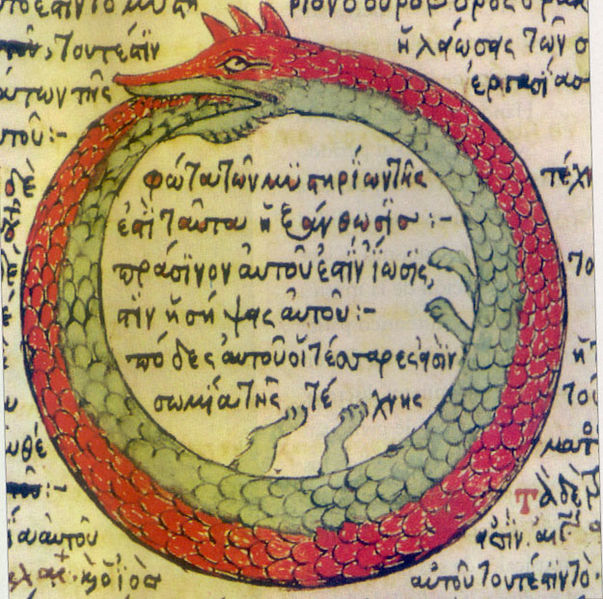
Ouroboros
The Mobius Strip


I came across this quote as a status update on Facebook a few days ago - "Those who are wise lament neither for the living nor the dead. For death is certain to one who is born; to one who is dead, birth is certain; therefore, thou shalt not grieve for what is unavoidable." These images of the cyclical are all too familiar. What begins ends, what ends, begins. But what if nothing ends and it is completely vital to shift gears and begin elsewhere just to save yourself from one kind of endlessness and begin another. A violent proposition of constantly spiralling out. An asceticism that pushes towards discomfort and constantly escapes the comfort of its routine.

~


The archaeological site is a site of projected possibilities into both the future and the past. An end point  and a beginning at once, waiting, pausing and pushing the moment of the action just a few more centuries away. Like Apu who decides to miss his train and stay at home one extra day.[Aparajito (1956) Dir: Satyajit Ray]

"Imagining oneself as a child is like running backwards. Imagining oneself ancient is funny, like a dirty joke." 

Agnes Varda 
 ~
The image below is a frame from Agnes Varda’s film Les plages d'Agnes (the Beaches of Agnes) (2008). 


For a long time I struggled with this image that has ever since been my obsession. I see in my imagination, the trapeze artist swaying from one trapeze to another, tossing into the sky further and further until one fine day managing to hook onto it with an umbrella and hang in suspension until further notice. The umbrella has a pencil point with which the trapeze artist can write on the sky, draw tails and signatures of acrobat-kin. But the imagination was in a spasm of trying to actualize an impossible image. The sky and the universe as being an ever expanding material that refused to show itself. 

Yesterday , while wandering in the Science museum in London, I found this. 


The caption reads as follows:
Glass Sphere
This rare example of a celestial sphere belonged to Stephen Demainbray, a lecturer whose collection becae amalgamated with the royal collection. It was designed by Robert Long in 1742. The Instrument was used to demonstrate both the real and the apparent motion of the heavens by turning either the Earth globe or the glass globe. The glass globe is engraved with the major constellations.

Here was an image of the world and its sky- with a beginning, with a circumference. The glass globe as the sky helped me stand outside of it. Made it possible for me to imagine my trapeze artist finally having a surface to fall into. Skyfall was within reach.  

The moment of labour is the one suspened in between the two bars - mid–air when she turns and begins her next journey to the other trapeze, without a safety net below her. It is the work of a beginning. A moment of courage that begins by the momentum accrued by her self set in motion by the trapeze pushed by the friend on the other side, her acrobat-kin.

Beginning now.  


Friday, June 8, 2012

Apichatpong's Tropical Pulse


I discovered Apichatpong Weerasethakul in my global art cinema class taught by Dr. Mark Betz. We were shown his film , ‘Syndromes and a century’ and were left quite disoriented at the end of the film.  After then, having seen Tropical Malady and Mysterious object at noon , it is only but evident that this filmmaker has his emotional quotient very deeply rooted with his people in Thailand. Apichatpong’s narratives seem to have the lightness of a grasshopper, effortlessly moving from one figment to another, yet , binding all these figments in a close network of emotional  ties, which weave the film into a overwhelming mood piece.

While watching his recent short , Ashes, shot using the Lomokino , which premiered at Cannes this year, the most eloquent aspect of the film that struck me was his keen ear to the sounds of memory. The visual aesthetic of the flashy overexposed film lends itself the hazy misty air of transformative contingent recollections. The dog  on leash, the ambitious pig in the sty,  the sounds of birds in the distance, of rustling palm leaves on a breezy coastal afternoon, of steaming rice in the kitchen , and a stroll in the evening, all these little details are intuitively captured. The film gradually shifts into craftwork when the filmmaker overlays the same ‘home’ footage with digitized aberrational sounds that echo a certain kind of appropriated pulse of technology. Ashes , performs a simple act of placing a finger on your wrist to place your pulse.  

A similar pulse ran through his first film, Mysterious Object at Noon, which uses both enacted and documentary style of filmmaking , to present a collage of deeply personal narratives that evolve around myths and folklores of Thailand, and emerge out of a vernacular sensibility . There is a sense of nostalgia in every fragment , a revocation of intimacy and helplessness. The mise en scene has touches of tactile everyday domesticity. The film which explores a narrative based on the game of spontaneous story building , which the surrealists indulged in, therefore , opens up the margins of the film. The film makes room to allow moments of collapse of the control of the camera. The pace of the film is as if the whole two hours of viewing were drowned into a time warp bubble, the heart beats of the audience seem to race beyond the pulse of the filmic experience.      

The story of a mysterious object which turns into a  mysterious boy who is said to have killed his teacher , gains life, like a local myth, through its renewal and retelling through various people . It turns into a seed to develop different modes of performing the story , while at the same time allowing for spontaneous filmic siestas . The element of magic , of course, is the tiger , which enters the plot towards the end,  into the hitherto human story , which pushes the realm of the narrative into becoming a fairy tale, the storytellers being curious and inventive school kids. The tiger finds again an important part to play in his ‘Tropical Malady ‘, again resorting to a dispersed thread of narration of folklore. In ‘Syndromes and a century’, the vast slow camera pan around the different urban and pastoral locations , and elongated time lapses generously given for the spaces themselves to emote and take forward the film’s mood, reflect a keen sensitivity towards spatial emotive topographies , that perhaps could have come from Apichatpong’s primary training as an architect prior to his education in fine arts and films.
His regular video art pieces and shorts, which have been produced religiously over the years , alongside his long features , seem to help keep agile his film craft and inventive  fervor. Apichatpong’s cinema seems to resonate with a certain wisdom . A wisdom which is nurtured by the international fraternity and as apparent by the widespread press coverage, is celebrated as a unique coming together of a global and a regional sensibility in the filmmaker.   

Tuesday, June 5, 2012

Daily visitor


He comes and
sits on that
little nervous tree
with no roots.

Last summer
the tree would bear
fragile pink
paper flowers.
now it seems bored.

He has little
humourous wings that dance
as he croons
deep and adamant.

The firing hearth next door
wafts up an endearing smoke,
from a distant memory
of a personal place.

His uncertain neck
pulsates to the beat
of the hapless city
around it,
Twisting and turning
like a restless baby's wrist.

The fresh henna on her hand
smells a deep orange,
finds voice in him,
strikes roots in the tree.

In an anchored hour of
sunseived shade
the tree shivers
in the warm
afternoon breeze. 

Sunday, March 11, 2012

Evening Walk

Evening sands, billowing in the breeze, were creating a little storm in between her toes. It was still a long way till dusk set in, and she had walked long, almost frantically, trying to shake off the stray birds of thought that kept nestling in her mind. Walking was an automatic intuition.

So she set forth on her way back, her blue cloth bag on her shoulder still swinging with little crumbs of sand grains and broken bangles. She seemed oblivious to the sun that was setting behind her. She was looking forward to meeting a new friend whom she hoped to run into , on the main beach. Having made no rendezvous promises or appointments, they had allowed themselves a small door to a serendipitous thrill .

Their first encounter had been like an old petal found in the yellowing pages of a favorite unread novel. Without a beginning, without an end, she had chanced out of humming voices and salt water reveries, just like a fading fragrant petal emerging from floating words and images of the book. As the familiar stranger had exchanged formal greetings and set forth on her way, the wide eyed five year old had called out her name from behind her back, ran up to her and grasped her hand with absolute authority, and taken her to the sea. This new curiously towering ‘Akka’ was her license to play with the waves, and she was not going to let go of her so soon. And so, the next day, with excited anticipation, Akka’s long beach walks had promises of turning eventful.

The waves seemed to have more white foam that day.As the sun set far behind her, wallowing in neglect , Akka spotted her little ball of fire in a distance. There she was, running in circles around her father. He , was sitting with a hunch , complacently distant in thought from this little satellite that was taking its roundoos, almost like a ritual. Her little palms clenched tight, arms outstretched she seemed like she was on her own roller coaster ride in neverland.

On that day, Prathama was wearing blue cotton shorts and a white smugly fitting blouse with a playboy bunny in pink glitter on her chest. She was careful not to venture too near the water. She harboured an illicit attraction towards the waves, which she was not allowed to tread into alone. It was a love hate relationship with the sea. She could curse it, embrace it, caress it, kick it, throw imaginary stones at it, play hide and seek with it, and it would never let her down. It would always come back.

‘ You are late! You don’t keep up your promises!’ , she complained as she ran towards Akka , who she saw approaching in the distance.

Akka bent down and Prathama clung to her red checked shirt with moist sandy salty hands.

‘ I’m going to walk till that end of the beach’, said Akka, pointing towards the hillock at the end.

‘ Go and come back quickly!’ , grimaced Prathama , as she ran back to circling her appa. Midway , however , she had a change of plan , and ran back behind Akka, and tugging at her shirt, said ‘ I’ll also come with you.’

So the two of them set off to take a walk right up to Ramateertha. Prathama dint know where she was going . She had just wholeheartedly surrendered to this two day old stranger. However, distances had conspired to deceive the five year old.

Amidst fellow kids, building sand hills , and turning into objects of Prathama’s curious envious glances, and past the town’s housewives, with sarees tucked up at the waist, who had come for the daily evening walks , two trails of footsteps made their way. It is ‘walking ’ , not ‘walk’ corrected Prathama. She seemed to be present forever in the present continuous.

It had been two weeks. Whispers were making rounds of the little temple town. Mabla was nowhere to be seen; not hanging around the regular Maitri juice centre with his friends in the evenings nor at the late night arom boards games at Sanna bele Mabu’s place. Mabla’s gregarious laughter that usually resounded in the town every time he passed Rathabeedhi on his noisy motorbike, had suddenly fallen silent. The reporter of the town surmised the turn of face as a result of cynicism. ‘Mabla has turned cynical’, he said to peers. So it was on everybody’s lips ; of fellow shopkeepers and grocery store owners, of the retired schoolteacher who spent every afternoon sitting on his front porch katte , fanning himself with a Chinese fan that an odd beach hopper left behind as a token of appreciation for being given legible directions to Om beach, and of the Rajasthani boy who spoke impeccable kannada and sold his disposable beachwear for no less than double the market price. ‘Mabla has become cynical , maraithi. He doesn’t talk to us anymore’. ‘Did something happen? Did some friend betray him? Is he hiding something from us?’

A town would not remain silent , if one of its own goes silent. Many phone conversations featured the recent face-turn of Mabla. ‘ You remember Mabla? The loud large hearted man with the cute little daughter ? I don’t know what has happened to him, he has turned cynical since last week!’

What the word ‘cynical’ really meant did not really matter to the rumour hoppers. Its sounded mysterious and that sufficed.

Along the shore, the two dotted figures made their way . Prathama and her Akka were now somewhere past the main beach, as the rock divided the shore into a smaller lesser inhabited beach, sanna bele . The little boys with their sand castles were left behind. The saree clad walking women had far drifted away in the opposite direction , almost in a gleeful joy of disappearing into the horizon , if only temporarily , before they get back into their domestic dens.

The waves were turning grey. The evening sun , quite without warning had slipped out of the frame and let the clouds take over a magnetic magenta sky. Evenings were confusing by the beachside. One moment, it would be a feisty celebration of light in the sky and the faces of the town would turn golden and crisp with a sepia aura .The next moment, the town was an abandoned child , reveling in the momentary nostalgia of the feast they just witnessed, and trying hard to remain cheerful in it , even as the sea turned grey and black almost helplessly.

It was past sundown and the grey threathened Prathama. Suddenly , she looked up and saw no one around her. Who was this tall girl , she had come along with? She dint know her. Where was her appa? Where was the town, the noise , the children? She looked down at her feet, and her tiny chappals suddenly started to feel like they were shrinking. She saw Akka , now, pointing towards a rocky shortcut that led to the path to Ramateerth, which was where they were headed. But something felt fishy. It seemed like she had been walking all day , and yet, Akka was saying they had some more distance to go! How could that be possible?

And slowly almost without her knowledge, she started whining .First mildly and then emphatically. She realized she had to act, she must speak out, that she couldn’t be taken for a ride , by her strange tall friend. The unfamiliarity started caving in on her. The beach looked monstrous. She stopped dead in her track. She wouldn’t walk anymore. She just stopped and sat down in her place, hoping her resistance would be heeded.

Akka, was now , helplessly confused. She had no choice but to have to go to the end point as she had to run an errand for her grandmother. So , now with her little bundle of gravity that had planted herself to the ground, she tried negotiating. ‘Just a little bit more and Il get you an ice cream’ , ‘Just a little more and we’ll soon see your appa’ , and so she bent down and picked up Prathama , who was now belligerent . She tried to wriggle her way out of her grasp but Akka was holding on firmly. And then in a fit of sheer helplessness, she caught hold of the elastic necklace that Akka was wearing, which at the moment looked magnified with its round green and brown beads, and slapped it down on the road. Akka was under attack , quiet out of the blue, an unexpected turn of mood she had found herself in. Picking up her necklace from the ground, they lumbered their way up the temple.

At the gate , Prathama refused to budge yet again. In a fit of desperation, Akka took the absurdly irresponsible decision of leaving Prathama behind at the entrance alone, as she ran up to the waterfount to fill her bottle with mineral water for her grandma ; all the while the sound of Prathama’s loud wailing ‘Appa, Appa, Appa’ following her in the background.

The nightmare was only getting worse by the minute for Prathama. So as much as she had hoped her necklace wrenching act would gain her some attention, to her horror , she now found herself, all alone on the steps of Ramateertha , as she saw her only hopeful savior run away from her! She could only wail louder. It felt like a moment of disconnect from the entire time line of the sleepy town. Although just for a couple of minutes ( but minutes can turn into eternities) , this little girl was synced out of her time, and placed in the timeless frame of an evening made of lonely strangers, grey and passionless. Like a sticky green leaf lying incoherently on a corrugated tin roof, Prathama quivered as the chilly evening sea breeze made the ribbons in her pony tails dance.

There was a little wound on her elbow, from her recent fall in her recently concreted courtyard. Raising her little stubby fingers to her face to wipe out her eyes , tears and kohl made a puzzling pattern with the lines on her palm. The four minutes , that Prathama spent, on the steps of Ramateertha , were like a lost piece of film spliced with a new film reel.

Akka was back; the little lone girl hadn’t been abandoned after all, there was a glimmer through the grey.

Lifting up her little screaming bundle , Akka now, made her way as quickly as she could , down the steps and back on the beach, now in a mad rush to get the daughter back with her separated father. Prathama was getting heavier by the step and the slender frame of Akka was exerting all its reserve of energy to carry this bundle back to its rightful people.

As they finally neared the main beach , it was dark. The faces had turned fuzzy. Here and there , were groups of townspeople extending their last moments on the beach, before they headed back in to their sultry deep homes. Peering keenly across the people sitting there, Mabla was nowhere to be found. Prathama had cried her throat hoarse, ‘Appa, appa’ and refused to walk any further. She stayed put like a furious sage. She had been deceived by the uncanny ways of this suddenly formidable world.

Looking around for help, Akka recognized the familiar face of the retired postmaster who was sitting with his friends. He gave her an inquisitive look ,sympathetic at her plight. Akka asked him if he had seen Mabla anywhere and he replied saying maybe he was sitting a little further away , he hadn’t seen him .Trying hard to recall where exactly, they had left the morose stooping father back on the beach, Akka tried hard to figure out from amongst the blurring silhouettes seated in the shrouded evening , on the shore. The man was nowhere in the blurred strokes of that evening.

The little girl’s throat had gone soar, as her tears now started mixing with the rising tide and turning the sea a little more salty. Her fingernails dug into the sand, the black silicon from underneath, etching its way out through the gaps in between her fingers and making its way up to her eyes in place of her washed out kohl as another pair of eyes scanned the horizon , searching in vain for a figure in waiting ,and finally resting on a rising tide , that receded with a tiny chappal floating away into the dark distant.

***