Saturday, June 26, 2010

FA 2010 - FTII, Pune


The Prabhat Bell calls for take.

Shot number 35 ! Film Appreciation 2010 ! Lights Camera Action ! Clap !

We are serenaded by the lilting and suave notes of our Pied piper , Suresh Chabria ji . With his magic lantern , he invites us into the powerful hypnosis that is Cinema. Synesthesia sets in. Our senses blur as the screen before our eyes lights up with Sergio Leone’s gunned outlaws, Kubrick’s waltzing spaceships, the inevitability of Apocalypse Now. Yes it is Apocalypse Now. An Apocalyptic dose of cinephilia.

Where is the Friend’s home? Kiarostami asks us on the first day, and we set out on a quest in search of our old friends, Films.( By the end of the course we pride in calling ourselves Foofs ; Friends of Old Films) We wind down the cobbled streets of time , and encounter our great grandfathers, the Lumiere Brothers, George Melies, D.W.Griffith and many more. We walk through the Narratives, past the Tableaux , up the hills of Montages, sail past illusory lakes.We enter the world of Sonimage, now Real , now fragmented, through Surreal waters, and ride the gales of wretched Realism .

Edvard Munch Screams through the Cabinet of Dr.Caligari, and we know the Germans have Expressed through their Metropolis! As the Bicycle thief rushes past us, and we are left stranded on the pavement watching Breathless, Pierrot the fool, catches us unawares and splashes the walls around us with colour! Swept away by the Wave of the French Nouveau, we land in midst of a Red Dessert, and find an oasis of metaphors, satires, the Blues of a trapped lady, the Reds of passion blood , the yellows of summer and sadness. We walk into the lush green fields of an Ozu landscape and find Seven Samurais waiting to attack us with an effusion of Kurosawa’s passing seasons.

Eventually, we enter the Noir streets of the city , chased by shadowed figures, dark alleys, gunshots and cornered by femme fatales. Now and then a train rumbles along , and dark smoke shrouds the immaculate conscience of the city, making the city a place of the anti-heroes and Helens. We waltz to a labrynthian city symphonies and take a high ride with Thelma and Louise.

Meanwhile, halfway across the world, three fathers ,V. Damle, V.Shantaram and S.Fatehlal sit under the wisdom tree of Indian Cinema and sound the Prabhat trumpet into history. In the distance, standing on top of the great Mount Melodrama, Nargis holds the cross on her shoulders, and questions her son, “Tujhe ma chahiye ya chaney?” This is the quintessential Indian emotiscape, the Indian Madonna who sheds rivers of blood to inundate fields of a Bharat who brackets his stories by proclaiming, “Mein Bharat hoon” while, somewhere in the dingy lanes of this Bharat , a cynical bard sings ‘Jinhe naaz hai hind par who kahaan hai?’ We are yet to get an answer to that question amidst throes of War and Peace In the Name of God.

We meet Bhai Miyaan and Bilaal, go in search of The other Song with Rasoolan bai, and marvel at the Great Indian School Show. The Digital Camera takes us a step too close to the human mindscape of Love sex and Dokha .

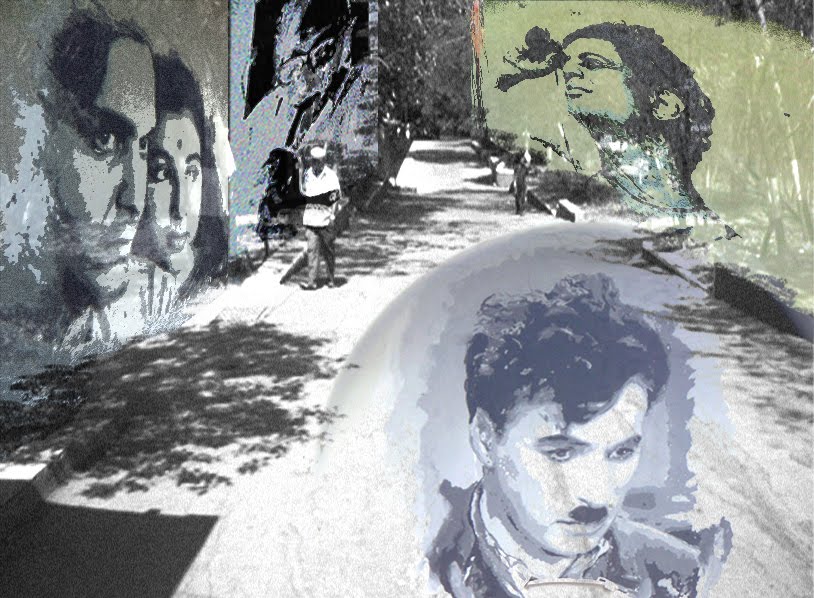
In the midst of it all it rains. The fancy umbrellas are out . The streets are sparkling wet in the early morning mist. The Chaplins, Mrinal Sens, Kurosawas, Toshiro Mifunes, Satyajit Rays and Ritwik Ghataks in FTII soak in the monsoon’s first showers and greet us with wizened visages as , we take our final walk down the FTII street, and meet again under the wisdom tree to sing songs of a new bond. We are the FA 2010.

Thursday, April 29, 2010

Sunday, March 21, 2010

A scene from Akahige (Red Beard ,1965) - Akira Kurosawa


Chobo, the little urchin thief , lies on the hospital bed , struggling for life , after consuming poison. Till yesterday he was chased away and cursed by the hospital nurses for stealing rice from the kitchen . Today, the nurses worry for him, as a mother for her dying child. An old myth of the hospital says that if all the kin of a dieing person called out his name into the well in the courtyard , the spirits would send him back from the otherworld. “ Chobo! Chobo! “ his little friend Otoyo ‘s screams echo from the well. Together , Otoyo and the nurses , bent upto their waists into the well, salty tears dripping into the well, call out, “ Chobo! Chobo!” tearing at their guts , as if their voices would lend life to the well. The sobbing screams pierce the silent air of death around. The water in the well ripples with Chobo’s final breath.

Thursday, March 4, 2010

Louis Kahn in Ahmedsaa Badsaa's city


Glittering city lights like neurons and cells spreading their connectors around. I enter IIM-A campus. Sodium lights reflect off lofty walls, all of brick and awe. I cant help feeling the excitement slivering through me. Sriram kaka takes me on a late night tour of Louis Kahn’s monastic campus, the Indian Institute of Management – Ahmedabad. It is shivering cold at 11 in the night and mist has descended over the brick fortress. Through the arches and student blocks with their heavy buttresses anchored to the ground, the bricks overwhelm one’s vision. In the almost ethereal walk at midnight, I suddenly run my hand over one of the walls, feeling brick and mortar in an attempt to make sure it is all real. The sudden slants of the brick arches and hooked lintels that defy the constricted massiveness of the built, take me by surprise. All at once, I am overcome with a sense of depression. I feel sad somehow, for the building. For the bricks that are stuck in there for eternity. For Louis Kahn himself, the outsider who came to this foreign land and sought to manifest and trap himself within the stoic bricks of India. I can almost feel that intensity of nothingness in those humungous circular punctures on the walls. With exotic migratory species of birds filling the midnight air of IIM with a morbidity of their screams, IIM falls asleep brick by brick.

The morning is almost shaken from its slumber by the hair raising chirping and rattle of what seems like a battalion of birds in the campus. House number 413.M.S.Sriram has peacocks in the garden. I go on another round of the brick fortress. This time it appears quite harmless and vulnerably exposed (literally) in the bare open. We maneuver through the great Louis Kahn court which looks like a great grand father whose grandchildren have not yet woken up. Walking past empty classrooms awaiting their designated students(quiet literally as each desk has the students name plate on it! ) the great Vikram Sarabhai Library ‘s circular arch looks ready to engulf the entire place like an enormous black hole. A mango tree gives the Harvard steps at the entrance a human touch, while an enormous Stanford ramp extends an invitation into the belly of the bricks. Meandering through the hostel blocks, I feel small, as moons of windows loom large above me giving glimpses into the life inside. While Kahn’s bricks make the old campus, Bimal Patel ‘s exposed concrete makes the new campus. I like the relief of the lightness of grey after an overdose of heavy brown bricks. Although in places there is the indecisiveness of a modernist, the new campus tries to balance well.

The Forum ( my reason for visiting Ahmedabad) is at Cept university. The place looks worn, active and full of sand. Having had some godlike image in my mind after having heard so much about CEPT as “the place” for architecture, I am left confused with mixed reactions. Well, that is always the case with having images and then seeing them shatter with reality. The great North Lawn, the mound where all beings lie down, looks inconspicuous and subtle. A pair of parrots hover up on the tree by the lawn. For the next two days, I spot them at the same spot, frolicking among architecture students, cement, bricks , panel discussions and rolls of paper.

Sabarmati is elusive. Only once, I get a complete picture of her, as I stand amidst the Ravivaar market, Ahmedabad’s 150 year old legacy, surrounded by cot makers, lamb traders and rising silt. Sabarmati Ashram , molded by Correa into an architect’s subject, stands across the river. I can imagine it once , as a lone standing hut amidst the sand across the river while the old city was only on this bank. Now the new city has engulfed land beyond the other bank and expanded around this little ashram mercilessly.

The blue windows of the old city are closed shut as I wander through them in the chilly morning of the Sunday. The labyrinth of pols and ols, take me into a cocooned city hidden underneath the bustling glazing of the new city. As we are taken through Ahmedsaa Badsaa’s city, where once upon a time even rabbits would chase away dogs , our guide in a peacock blue kurta churns out interesting tales of the place. Sculpted for life, a gujarati poet sits on the porch of his own house, stuck on a pillow with a book in his lap for eternity. Such a pity that , while hundreds of tourists gape with hungry lenses and goggled eyes, he himself is not able to turn back and look at his own house, which has undergone a facelift over the years!

Ahmedsaa ‘s secular city looks helpless under the weight of so many people. The old city quite literally apart from the new with Sabarmati cutting across. A multitude of exposed concrete, brick, modernist architectural jargon and a much publicized architectural following lies one side, while on the other bank subtle, aged , fading yet full of life, the old city tries silently to save itself behind blue doors.

Saturday, February 6, 2010

An Odomos sunset


An Odomos sunset,
A swim
&
A guitar,
Shoe strings
&
Music in the sand
A past left behind,
A cigarette stub in hand
Sea salt
&
Biscuits for breakfast
In anonymous land.


Wednesday, January 13, 2010

Oh Scarlett Oh Hara!

The name is not just a name, it is a symbol. 'Oh scarlet oh hara !' Margaret Mitchell was not playing around the weak hearted when she envisioned and gave life to this character that has ever since been immortalized by a staggeringly vivid performance by Vivien Leigh , the legendary British actress. The book of course, is the classic tale of a civilization ‘Gone With the Wind’ with Scarlett O’Hara at the centre of it all, the eye of the whirlpool in which she sucks in all people who ever matter to her and who eventually succumb to her ubiquity.

Vivien Leigh proved as the only person who could have take on this character so perfectly, and her own persona has beyond doubt added to the screen image of this masterpiece. Quite contrary to the defeatist little coy dancer, Myra, that Vivien plays in Waterloo Bridge, this remarkable character by the name of Scarlett O Hara is a conceited optimist, a go – getter who has so much energy and life that no room would be unaffected in her presence. She exudes herself into all surrounding things and quite without her knowledge, all things bend towards her, just like a field of sunflowers towards the sun. And just when one starts to think she could be the most remarkable person, Margaret Mitchell goes on to ruin every little reputation that could form in our minds by making her such a faulty and marred character, full of follies, fury and conceit, that she edges on being an object of hatred. Here is a selfish robust girl who cares about no-one but herself, many a times quite unknowingly. We watch with helplessness as she steers her life ruinously and recklessly all for someone, she has so naively talked herself into loving; the unattainable and married Ashley Wilkes. It doesn’t come as a surprise that every man she lays her eyes upon, is undoubtedly affected and appears as a helpless weakling before her.

Scarlett’s never say die spirit, takes her through the roughest times as we see a childish little schoolgirl transforming into a hard hearted, strong, and a ruthlessly matter-of-fact lady. She survives her war, hunger, and public detest. And she has no one but herself to give all the credit for it. It is a cruel portrayal the survival of the fittest, and fitting enough she turns into the predator and not the prey. From dancing in public as a widow, to acting as a midwife in times of riots, to plowing her own fields and doing business with the enemies to raise money, to riding her own horse carriage when it was considered unacceptable for ladies to even ride alone in public, there is nothing that she does not do to keep the promise she made to herself at during the hardest time of her life, ‘ that she would never go hungry again’.

Of course the whole world would topple on one side with such a strong unchecked force. So along comes Rhett Butler, the anti-hero, the deserter who is as conceited , as selfish and as hot blooded as Scarlett, but with more years behind him and with shrewd wisdom that is good enough to check Scarlet’s rampage. Only a diamond cuts a diamond; “sirf loha lohe ko kaat saktha hai”, as Thakur says in the Bollywood classic, Sholay. So Butler is the unlikely antimatter to our O’Hara matter. It is a welcome surprise that we are not in for any predictable romance blooming between them, but a peculiar love hate bond, which leaves each of them bitterer than the last.

Yet, after three marriages and a child, she is still a robust child, who wants to get back her 18” waist. She says she was never meant to be the marrying kind. She naively confesses that she can frankly love nobody else but herself. One could only affectionately laugh at this little child’s admission of her weakness and say ‘my poor girl, it took so much to get you to know yourself, but there, you’ve finally realized!’

It is a bitter sweet admiration between Scarlett and her readers. You never know when you start loving her, and the next moment she’d do something, you would absolutely hate her for. She is a living flesh and blood conjugation of our minds and aspirations, so real, that reality seems fake before her. Red as wine and warm as the sunshine on cotton fields, she is a true toast to life and a tribute to man, flawed and imperfect and beautiful.

Saturday, January 9, 2010

The Last Waltz

(photograph: Jozef Krajko. Source www.1x.com)

The Last Waltz

Standing on the window ledge of the 33rd floor,
She wonders why the traffic
Below is unusually still.

Yesterday's tequila glass
Still clinking in her ears,
She edges inch by inch
On high heels.
A black suede waltz
On the 33rd floor
On the 17th day of the 3rd month.

The music of the taxis,
Ringing like an orchestra,
All awaiting the lady in red,
To make the first move.
One step in front.
One step back.
Two to the right, one to the left.
Back and front.
Aaand let go.

Down on the pavement,
Beside a yellow cab,
A man in a tuxedo,
in black suede shoes,
and Elvis burns,
Heels clicked in attention,
And lips curled in,
Waits.

Up on the 33rd ledge,
She gets ready for the free fall,
Into the waltz of a lifetime.